
InsightsThe Care Transition: Planning the Later-Life Move Before It Plans You
August 06, 2026 • 7 MIN READ
Most financial plans are built to fund retirement. Far fewer are built to fund the last chapter of it: the move from the family home to independent living, and potentially onward to long-term care. For affluent BC families, this transition is one of the largest financial events they will ever face, and it is routinely the least planned. It touches the principal residence, the portfolio, taxable income, and the estate plan simultaneously. Handled reactively, in the middle of a health event, it can do lasting damage to all four.
Here is what the transition actually costs in British Columbia today, and how a structured plan keeps it from dictating outcomes you did not choose.
Stage one: independent living costs more than most people budget
Independent living residences, private retirement communities offering meals, housekeeping, and 24-hour monitoring, are the typical first move out of the family home. They are private-pay, and prices have moved sharply.
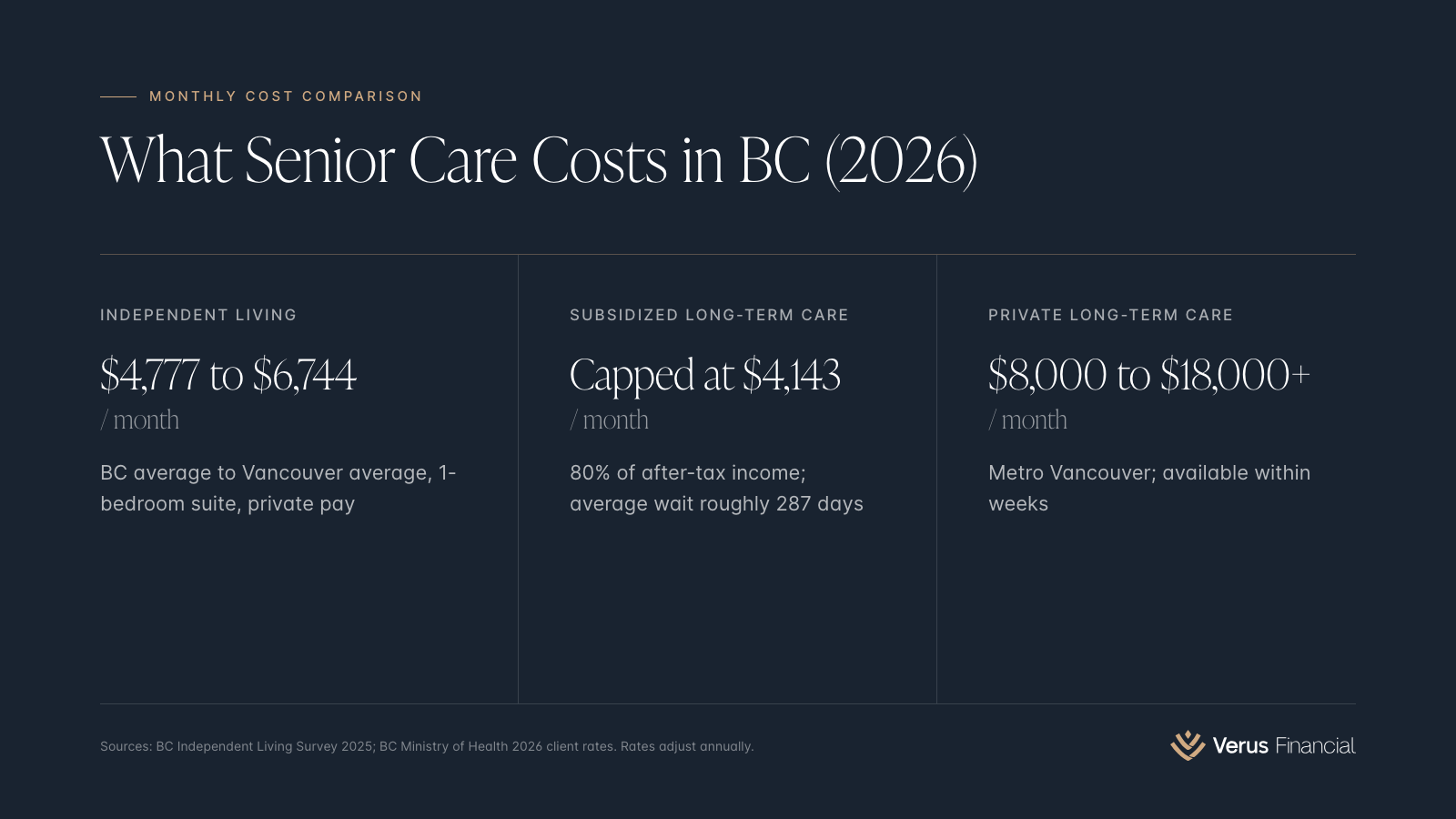
According to the 2025 BC Independent Living Survey from the BC Care Providers Association and Westbridge Group, the successor to CMHC’s discontinued seniors housing survey, the average 1-bedroom independent living suite in BC now rents for $4,777 per month, up 51% from $3,172 in 2018. In the Lower Mainland the average is $5,390, and in Vancouver proper it is $6,744. A 2-bedroom suite in Vancouver averages $9,670 per month.
For a couple, that is $80,000 to $115,000 per year in Vancouver before any personal care services, and operators have been implementing above-inflation rent increases to offset cost pressures. A plan that budgets on 2018-era assumptions is underfunded before the first health event arrives.
Stage two: long-term care, and the fork in the road
Long-term care is where planning quality shows. BC runs two parallel systems, and which one your family lands in has six-figure annual consequences.
Publicly subsidized care. If you qualify through your health authority, the monthly client rate is income-tested at up to 80% of after-tax income, with a 2026 floor of $1,507.70 and a cap of $4,142.60 per month. Note the arithmetic: the cap binds once after-tax income exceeds roughly $62,000. For most Verus clients, publicly subsidized care effectively costs the cap, about $49,700 per year.
Private-pay care. Private long-term care in BC typically runs $6,000 to $12,000 per month, and in Metro Vancouver, $8,000 to $18,000 or more depending on the residence. That is $100,000 to $215,000 per year, per person.
Why would anyone pay private rates when a subsidized bed caps out under $50,000? Access. The average wait for a publicly subsidized long-term care bed in BC is roughly 287 days, and the structural picture is deteriorating. The BC Seniors Advocate reports the province is already more than 2,000 beds short, with the shortfall projected to reach nearly 17,000 beds by 2036. Bed density is forecast to fall from 58 beds per 1,000 seniors over 75 to 41.
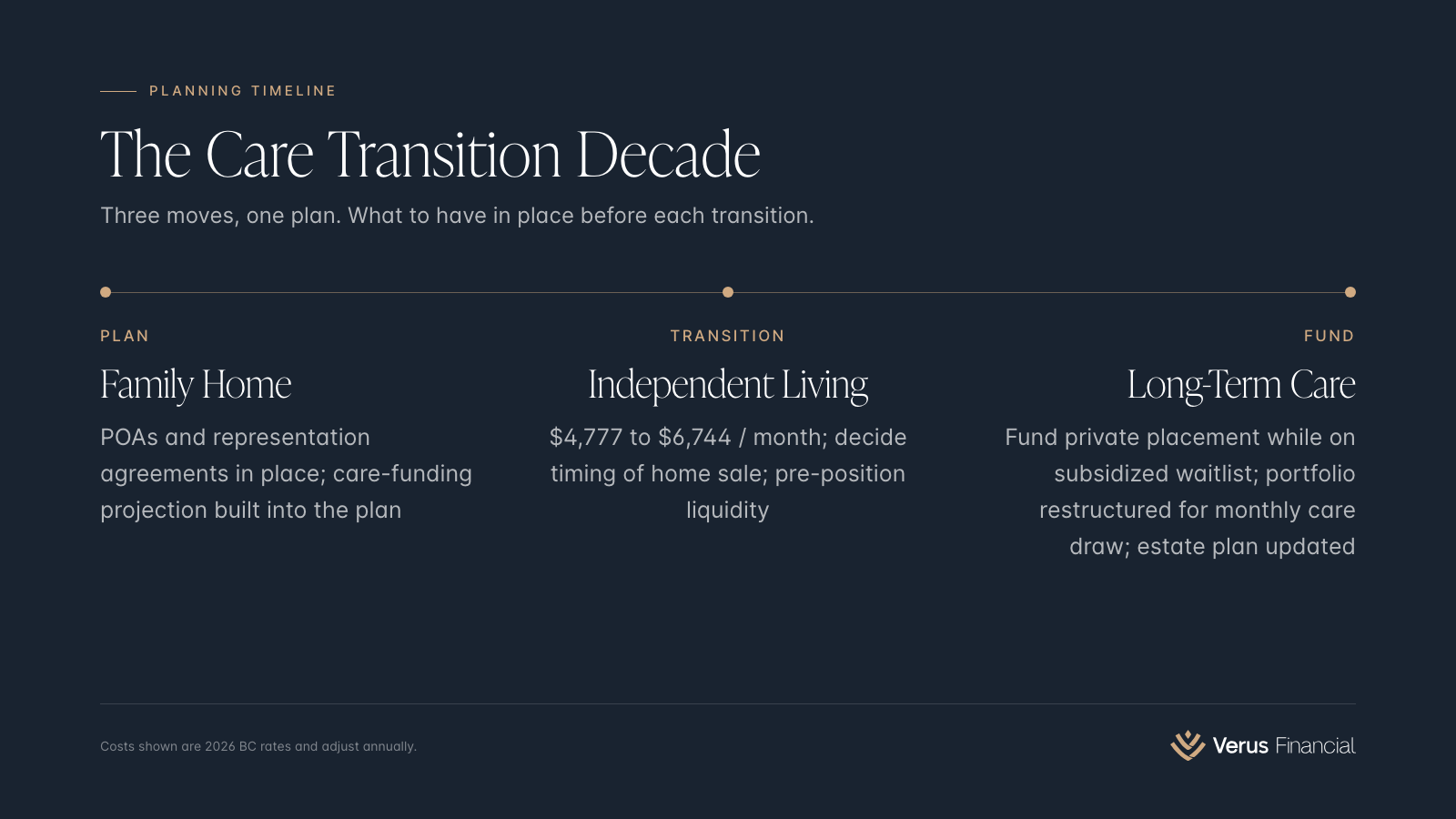
The planning implication is blunt: for affluent families, private-pay long-term care is not a luxury scenario. It is the base-case contingency. When care is needed, it is needed now, not in nine months. A properly stress-tested plan funds a multi-year private placement, potentially for both spouses, at $150,000 to $250,000 per year, while remaining on the subsidized waitlist.
The 80% rule cuts both ways
Because the subsidized client rate is calculated on after-tax income, your decumulation strategy directly affects your care costs. RRIF withdrawals, pension income, and taxable investment income all flow into the rate calculation. So do the same planning levers you already use for tax: the mix of registered withdrawals, TFSA draws, corporate dividends, and return of capital determines not just your tax bill but your monthly care rate, at least until you hit the cap.
For most high-net-worth households the cap binds anyway, which reframes the analysis. The real question is not how to minimize the subsidized rate. It is whether the subsidized system will deliver a bed, in an acceptable residence, on your timeline, and whether the plan can fund the private alternative without stress. That is a portfolio design question, not a tax trick.
Liquidating the principal residence
For most families, the home funds the transition. The sale itself is typically tax-free under the principal residence exemption, but the decisions surrounding it are anything but simple.
Timing. Selling into a soft market because care is needed immediately is how families destroy value. A plan made years ahead can pre-position liquidity, through a secured line of credit on the home or a dedicated liquidity sleeve in the portfolio, so the sale happens on the market’s timeline rather than a health event’s.
Partial transitions. Frequently one spouse moves to care while the other remains in the home. The plan needs to fund both households simultaneously, sometimes for years, before any sale proceeds arrive.
Redeployment. A Vancouver home sale can put $2 million to $4 million or more of cash into a portfolio that must now generate $10,000 to $20,000 per month of reliable care funding. That is a fundamentally different mandate than accumulation. It calls for a structured liquidity ladder, an income floor that does not depend on selling equities in a drawdown, and disciplined deployment of a large lump sum, often into markets trading at elevated levels. We addressed the deployment question directly in Should You Invest at All-Time Highs?
Keep versus sell. Renting the home out preserves the asset but converts a tax-exempt property into an income-producing one, raising taxable income (and the care rate calculation), triggering change-in-use considerations, and adding a management burden at exactly the wrong stage of life. It is occasionally the right answer. It is rarely the default one.
The estate consequence. Selling converts the most tax-efficient asset in the estate, a tax-exempt home, into a taxable portfolio that will generate income, realized gains, and ultimately a deemed disposition on death. The estate plan built when the home was the anchor asset is now out of date the day the sale closes.
The estate and incapacity layer
The legal architecture has to be in place before it is needed, because the trigger for the care transition is often the same event that removes the ability to sign documents.
That means current powers of attorney and representation agreements executed while capacity is unquestioned. It means an estate plan updated for the new asset mix after the home sells, including probate exposure on the enlarged portfolio and beneficiary designations that still make sense. And it means a family governance conversation held early, because in practice it is adult children who drive the transition decision, often under pressure, and often without knowing what their parents actually wanted or what the plan can actually fund.
Care costs also rewrite the estate math. Five years of private long-term care for two spouses can consume $1.5 million or more. Beneficiaries’ expectations, charitable intentions, and any equalization plans among children should be revisited against realistic care scenarios, not against the estate as it stood at 70.
This is what holistic planning is for
The care transition is where every discipline of wealth management converges, and treating them separately is precisely what creates the drastic portfolio and family impact. At Verus, we approach it as four integrated workstreams:
Financial planning. A care-funding projection built into the plan itself, stress-tested against a multi-year private long-term care scenario for one or both spouses, and revisited annually after age 70.
Investment management. Portfolio structure designed for the transition: a liquidity ladder for known care costs, an income floor that does not force equity sales in down markets, and a disciplined framework for deploying home-sale proceeds.
Estate planning. Powers of attorney and representation agreements in place before capacity is a question, and an estate plan updated for a balance sheet where the home has become a portfolio.
Tax planning. Decumulation sequencing that accounts for the income-tested care rate, OAS clawback, the loss of the principal residence exemption going forward, and the deemed disposition waiting at the end of the plan.
None of these works in isolation. A brilliant decumulation strategy that leaves no liquidity for a sudden private placement fails. A perfectly liquid portfolio with an outdated will fails differently.
If a care transition is on the horizon for you or your parents, even five or ten years out, the planning window is now, not at the point of a health event. Contact Verus Financial to build a care-funding plan into your broader wealth strategy.